Baby’s First Sensory Year: Simple, Screen-Free Play for Island Littles
Sensory play doesn’t need flashing lights. It needs carob pods, cool limestone and your voice.
5 min read
Search for “baby sensory” and you will find classes with bubble machines, light shows and music at full volume. Some families love them, and that is wonderful. But it is worth remembering that for a baby, the ordinary world is already intensely sensory. The feel of a linen sheet, the smell of bread from the village bakery, the sound of church bells, the coolness of a stone floor — all of it is new.
In the first year, a baby’s brain is building connections at an astonishing rate, and the senses are how the world comes in. The most helpful thing we can offer is not more stimulation, but the right kind: real, varied, gentle, and given with attention. Here is how we think about sensory play through the first year, with ideas rooted in Maltese life.
0–3 months: faces, voices and touch
Newborns see best at about 20–30 cm — the distance to a parent’s face during feeding. Your face is their favourite sensory toy. Talk, sing, pause and let them respond with tiny movements. Skin-to-skin contact, gentle massage with a natural oil after a bath, and being carried close all feed the sense of touch and the feeling of safety.
Visually, simple high-contrast shapes in black and white hold their attention. A single mobile with slow, natural movement — hanging above the changing area rather than the cot — is plenty. Avoid placing a baby in front of screens; their brains are not ready to process fast, flat images, and the evidence consistently encourages screen-free early months.
3–6 months: grasping and mouthing
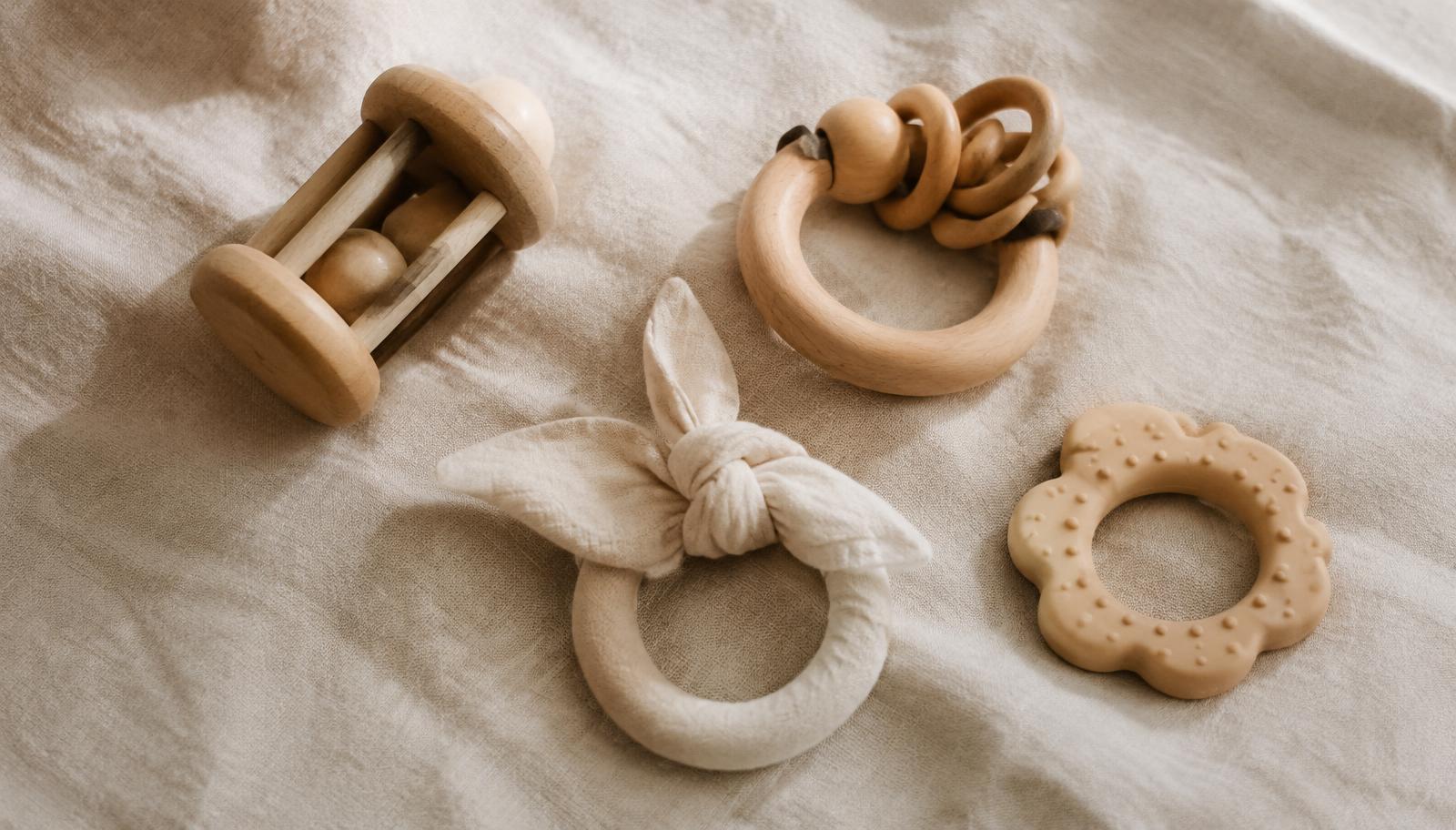
As hands discover each other, babies begin to reach. This is when a few well-chosen objects make a real difference. A wooden ring, a cotton crinkle square, a soft rattle with a gentle bell — each offers a different weight, sound and texture. Everything goes to the mouth, so choose safe, natural materials; our guide to plastic-free teethers and rattles explains what to look for.
Offer one object at a time and watch. You will see your baby turn it, drop it, find it again, test it with lips and gums. This slow, repeated exploration is exactly how learning works.
A baby doesn’t need a new toy. They need time with the one they have.
6–9 months: the treasure basket
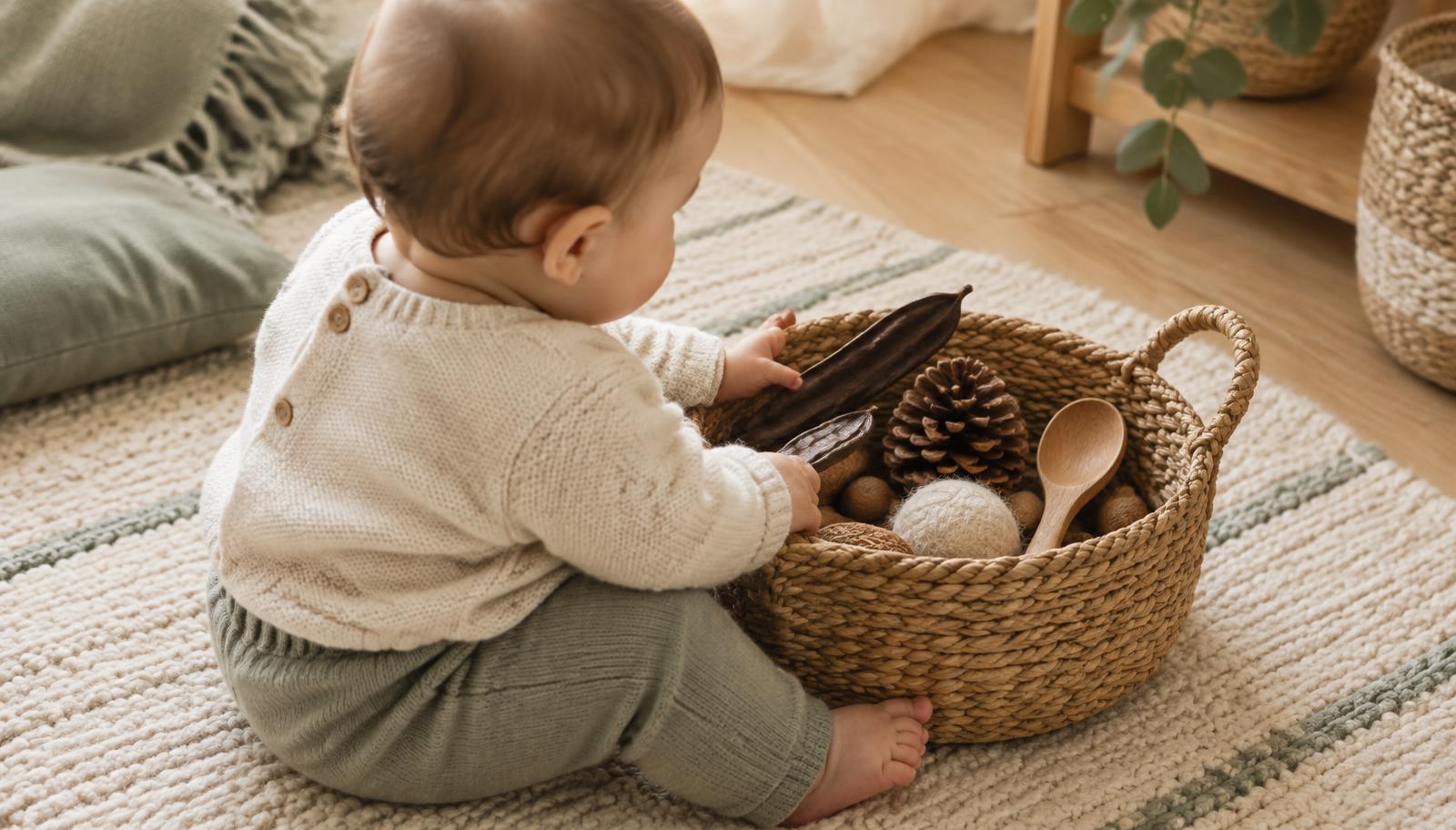
Once your baby can sit with support, the treasure basket is one of the most beautiful sensory tools you can offer. The idea, developed by early-years educator Elinor Goldschmied, is simple: a low, sturdy basket filled with everyday objects made of natural materials, each safe to handle and too large to swallow. Your baby explores freely while you sit nearby, attentive but not directing.
A Maltese treasure basket might include:
- A smooth wooden spoon and a small wooden bowl.
- A large, washed pine cone from Buskett.
- A ball of natural wool.
- A soft brush with natural bristles.
- A small metal tea strainer or measuring cup.
- A piece of linen and a piece of velvet.
- A large, dried carob pod (supervised, and checked for cracks).
Our Gathering Basket was designed with this tradition in mind, and you can add your own found objects to it over time. Always supervise, check items before each session, and remove anything that becomes worn.
9–12 months: cause, effect and movement
Towards the end of the first year, babies become little scientists. They drop things to see what happens, bang objects together, open and close, fill and empty. Simple wooden toys — a box with a ball that rolls out, nesting cups, a stacking rainbow — invite this kind of experiment. Our Little Landscape Rainbow becomes a favourite here, rocked, stacked and climbed through.
Movement is itself sensory. Crawling over different surfaces — a cotton rug, cool tiles, grass at the local garden — builds balance and body awareness. We trace these physical milestones in From Tummy Time to First Steps.
Malta as a sensory classroom
Living on an island gives us extraordinary sensory gifts, often for free:
- Sound: waves at Għadira, church bells on Sunday morning, birds in San Anton Gardens, the distant hum of the festa band.
- Touch: warm limestone walls, cool sea water on toes, sand at Golden Bay, the bark of an old olive tree.
- Smell: wild fennel and thyme in spring, bread from a village bakery, the sea air in winter.
- Sight: shifting light on the harbour, colourful luzzu boats in Marsaxlokk, leaves moving in the breeze.
Even an everyday walk becomes rich when you slow down and name what your baby is noticing. We share a whole routine for this in The Malta Stroller Walk.
Avoiding overwhelm
Babies communicate when they have had enough: looking away, arching, fussing, yawning or suddenly falling asleep. Overstimulation is especially common in busy family gatherings or loud environments. Natural, quiet toys and calm spaces help. Battery-operated toys with lights and repeated jingles can be fun in small doses, but they often do the work for the child, leaving little room for exploration.
In summer, heat itself is a stressor. Keep sensory play short, cool and indoors during the hottest hours — our summer guide has practical ideas.
Water and bath time
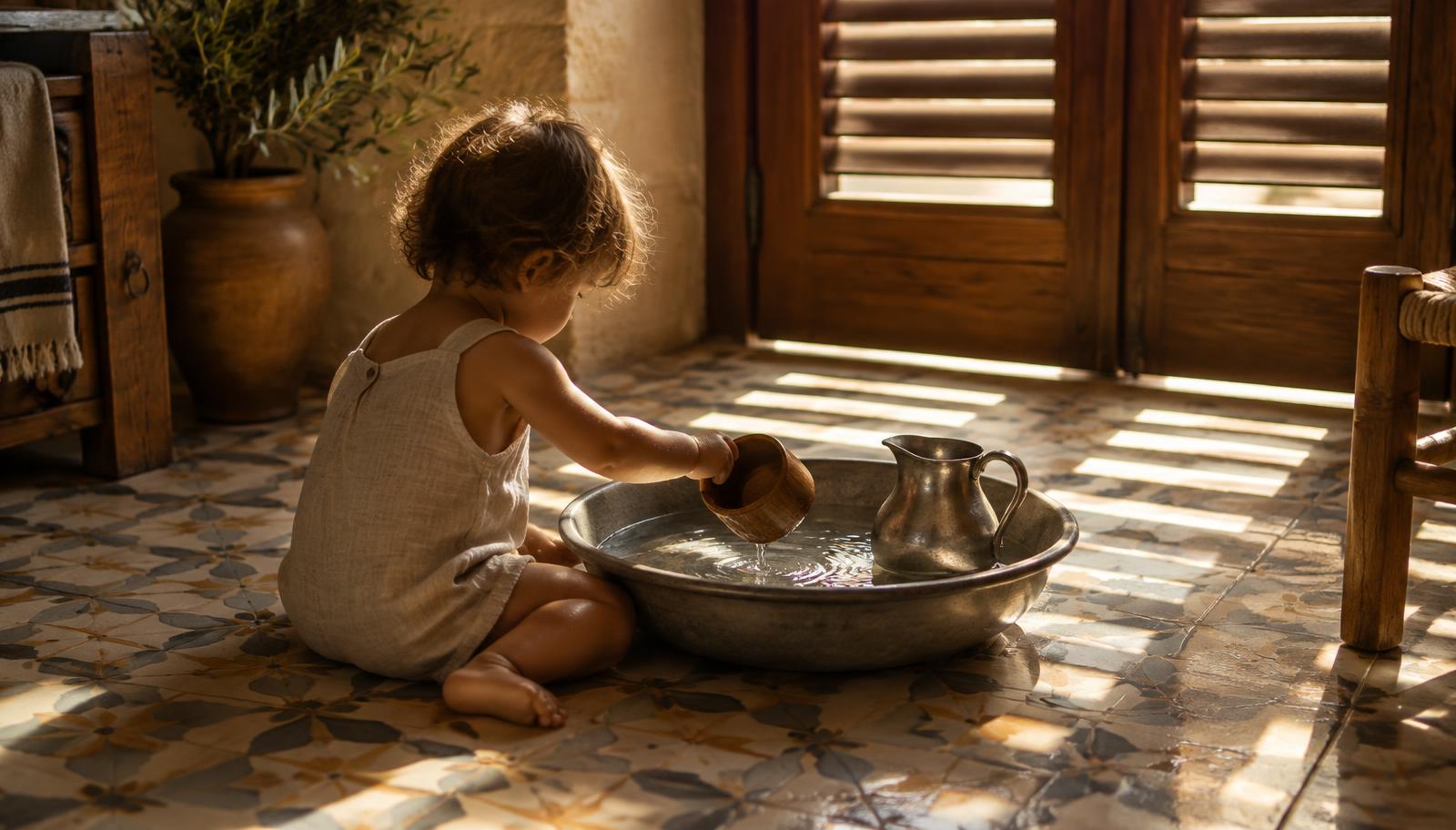
Bath time is perhaps the most natural sensory play of all. Warm water, the sound of pouring, the feel of a soft cloth. A simple wooden cup, a natural sponge or a small metal jug is all you need. Let your baby splash, watch the water fall, and feel it trickle over their hands. Always stay within arm’s reach.
Books as sensory experiences
Board books with simple, bold images, touch-and-feel pages and the rhythm of your voice are wonderful from the earliest months. Reading together combines sight, sound, touch and closeness. For our favourite first books, read Building a Small, Beloved Library.
The role of the adult
In sensory play, the grown-up’s job is to prepare, observe and protect — not to entertain. Set up a safe space, offer a few interesting materials, then sit back. Respond to your baby’s discoveries with warmth: “You found the cold spoon!” This attentive presence is the most important sensory input of all.
A sensory first year in Malta doesn’t require classes, subscriptions or a room full of plastic. It needs time, nature, a few beautiful objects and someone who notices. Find natural pieces for every stage in our shop.