Best Toys for a 9 Month Old: Crawling, Pulling Up and Wooden Discovery
Nine months is a busy, mobile age. These are the simple, plastic-free toys that meet a crawling, pulling-up baby exactly where they are.
4 min read
Somewhere around nine months, many babies stop being content to watch the world and start chasing it. They crawl under the dining table, pull themselves up on the sofa, and reach for every cable, cup and remote control in a Maltese living room. It is a wonderful, exhausting stage, and it changes what a good toy looks like.
At this age, the best toys are not the ones with the most features. They are the ones that answer the questions your baby is already asking: what happens if I drop this, where did it go, can I make it come back, can I reach it if I move? Here is how we think about choosing toys for a nine month old, and the kinds of simple, plastic-free pieces that earn their place.
What is happening at nine months
Every baby develops at their own pace, so treat this as a loose picture rather than a checklist. Many nine month olds are crawling, or shuffling, or rolling with great purpose. Many are pulling up to stand. Their pincer grasp, the ability to pick up small things between thumb and finger, is beginning to sharpen. And they are discovering object permanence: the idea that something still exists when it is hidden.
That last point is a big one. It is why peekaboo suddenly becomes hilarious, and why your baby will drop a spoon from the high chair forty times. They are experimenting. Toys that let them hide, find, drop and retrieve are perfect companions for this work.
Toys that reward movement
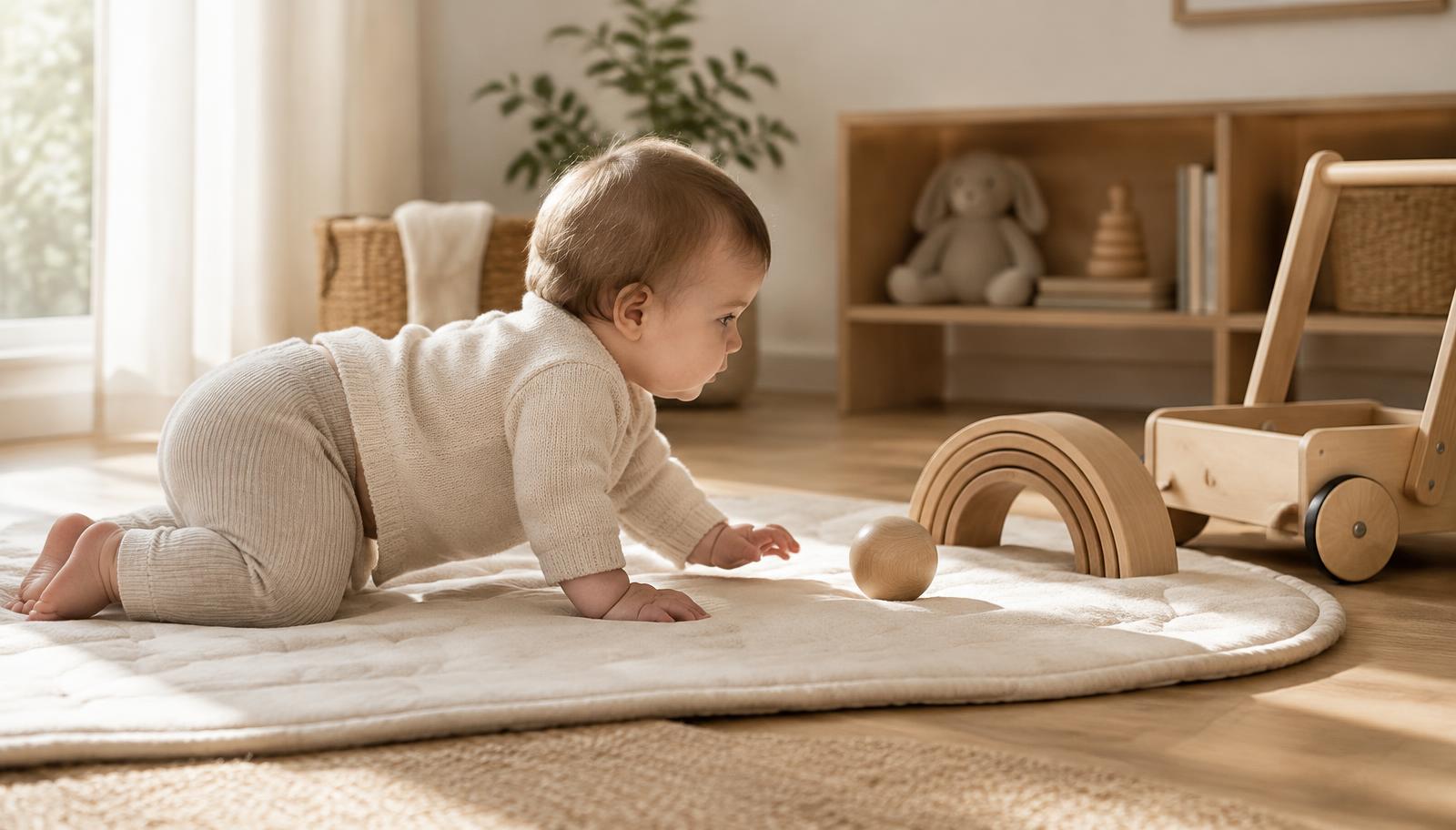
A wooden ball that rolls slowly is one of the best things you can give a crawling baby. Roll it a short distance across the tiles and watch them follow. A ball with a little weight and a smooth finish is easier to grasp than a hard plastic one, and it does not skid away too fast.
Low, stable furniture becomes a toy at this age, too. A sturdy sofa edge or a low shelf gives a baby something to cruise along. If you are thinking about a push walker, choose one with a wide, weighted base and resistance on the wheels, and wait until your baby is pulling up confidently. We wrote more about this progression in from tummy time to first steps.
Toys for hiding and finding
An object permanence box is a classic for good reason: a ball goes in a hole, disappears, and rolls out of a little tray. It looks almost too simple, but babies repeat it with real concentration. A small fabric scarf over a wooden animal does the same job for free. So does a lidded wooden box with something interesting inside.
Posting toys follow naturally. Anything with a slot or hole and a few pieces that fit through it will hold a nine month old's attention. You can even make one from a sturdy cardboard tube and a few large wooden rings, as long as nothing is small enough to be a choking risk.
Toys for hands
Stacking cups, nesting bowls and simple ring stackers are wonderful now. Your baby will not stack in order yet, and that is fine. They will bang, nest, pull apart, mouth and drop. Each of those is real learning about size, weight and sound.
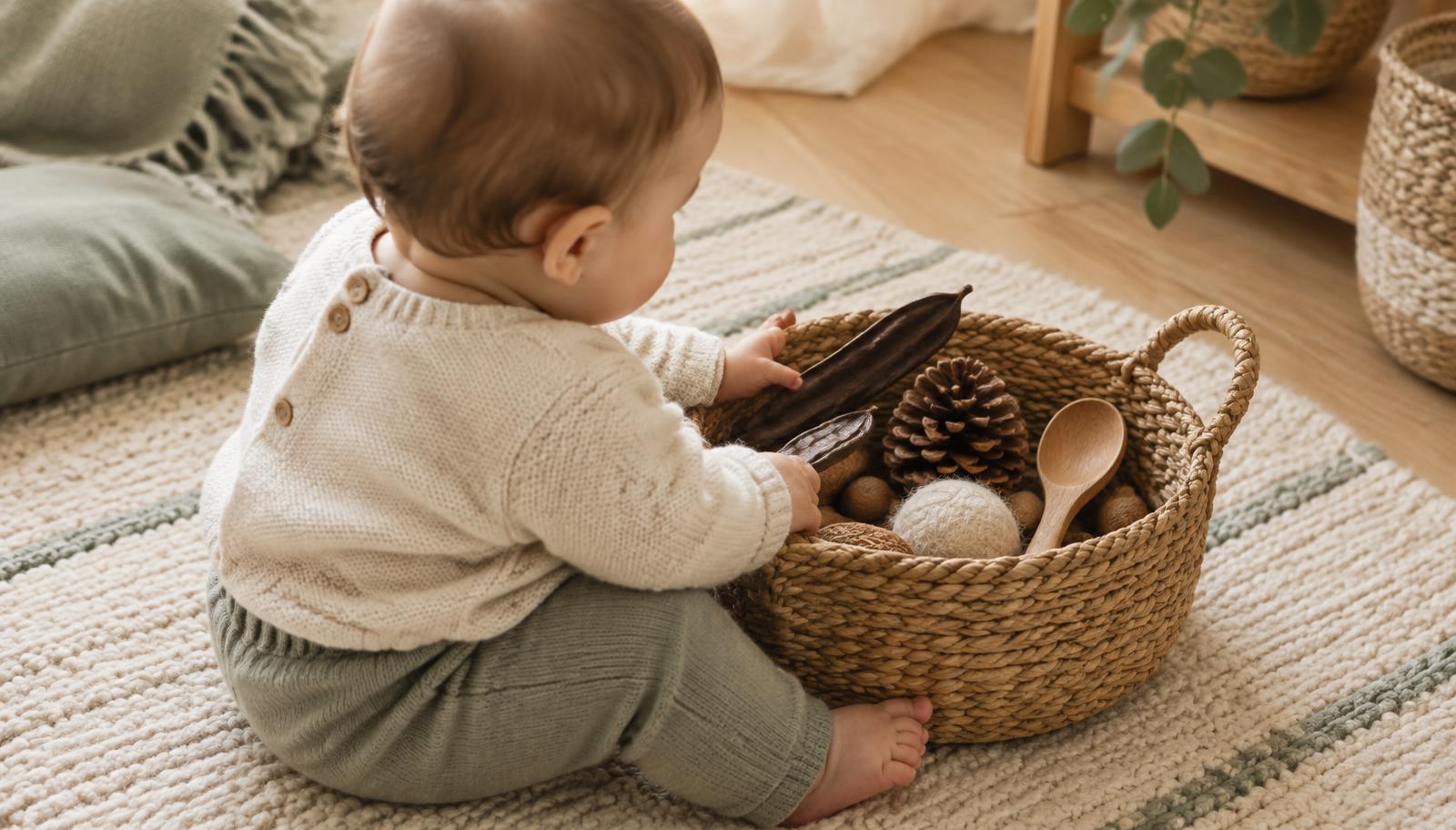
A treasure basket of everyday objects is still one of our favourite activities at this age: a wooden spoon, a small metal bowl, a natural sponge, a pine cone, a ring of keys made of wood. It costs almost nothing and offers far more variety than a single plastic activity centre.
Safety first, always
Nine month olds put everything in their mouths, and they are quick. Check toys regularly for loose parts, splinters and cracks. Look for the CE mark and conformity with EN 71, the European toy safety standard, especially when buying online. Anything small enough to fit inside a toilet roll tube is too small for this age.
Mobility also changes the room. Before your baby crawls everywhere, get down on the floor and look at your home from their height. Secure tall shelves, cover sockets, and move anything fragile up and away. A safe space means you can relax and let them explore.
How many toys do you need?
Far fewer than you think. Five or six thoughtfully chosen things on a low shelf, swapped every week or two, will keep a nine month old busier than a full toy box. We explain the method in our guide to toy rotation in a Maltese apartment. Rotating also means you notice what your baby actually returns to, which tells you what to choose next.
A simple nine month shelf
- A slow-rolling wooden ball
- A set of stacking cups or nesting bowls
- An object permanence or posting box
- A soft fabric book or board book
- A small treasure basket
- A natural rubber or wooden teether for sore gums
Looking ahead
By the time your baby is approaching their first birthday, many of these same toys will be used in new ways: the stacking cups become containers to fill and empty, the ball becomes something to throw. That is the quiet magic of simple toys. When you are ready to plan the next stage, our guide to the best wooden toys for a 1 year old picks up where this one ends.
Little Curio is preparing a small, carefully chosen collection for babies and toddlers in Malta. Until it opens, you can browse the shop to see the kinds of pieces we are choosing, or catch up on the best toys for a 6 month old if your baby is still a little younger.
More from the Journal: How to Set Up a Montessori Toy Shelf: What to Put Out and How Often to Change It, Montessori Toys for 2 and 3 Year Olds: Practical, Purposeful and Simple.