How to Set Up a Montessori Toy Shelf: What to Put Out and How Often to Change It
A low shelf with a few beautiful toys can transform play. Here is how to set up a Montessori-inspired shelf, even in a small flat.
4 min read
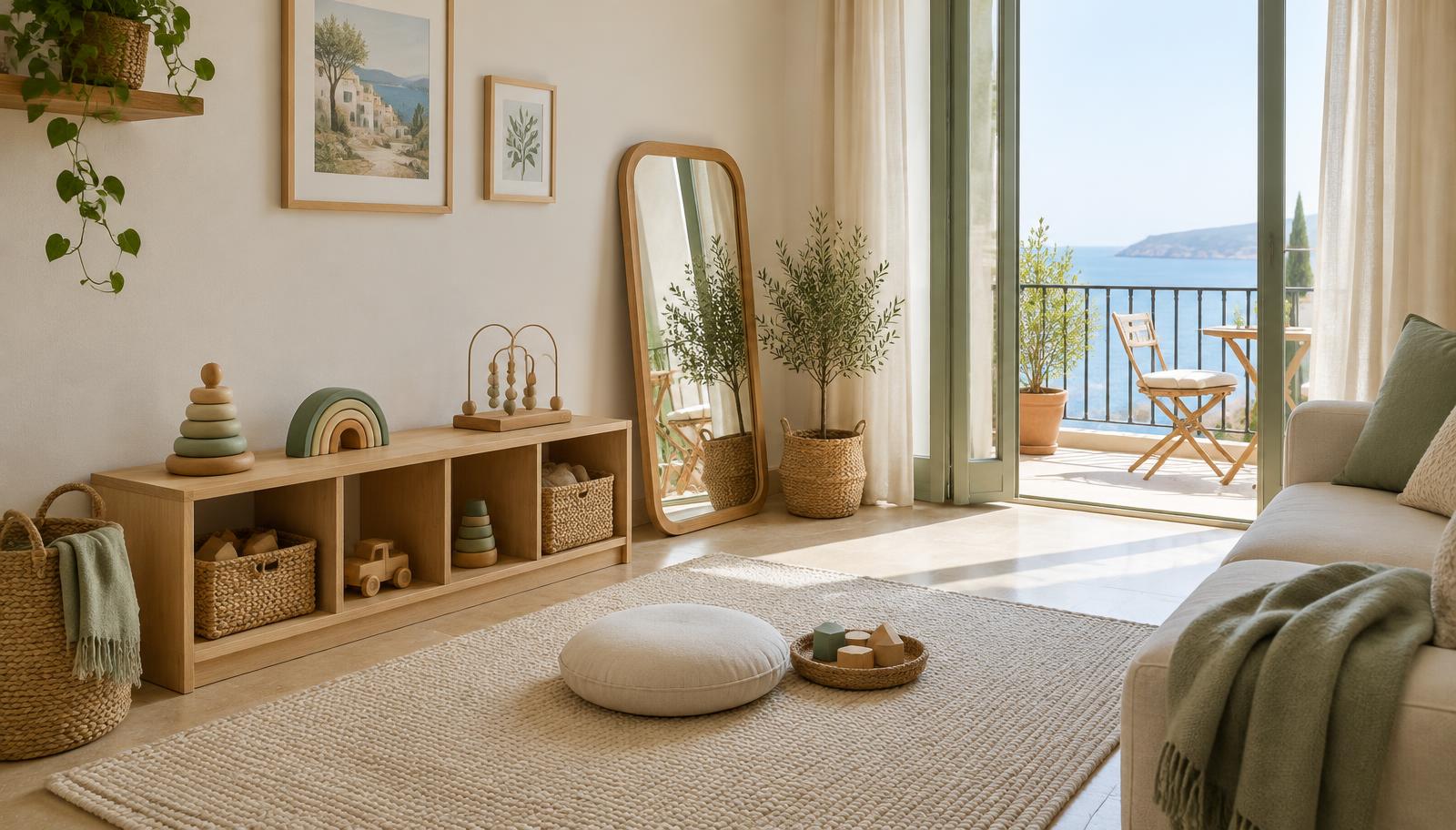
If you have looked at Montessori-inspired homes, you will have seen the low, open toy shelf: a few toys, spaced out, each with its own place. It looks calm and simple, and it often transforms the way children play. Instead of a toy box overflowing with things, children can see what is available, choose and return each toy when they are finished.
This guide explains how to set up a Montessori-inspired toy shelf at home, even in a small Maltese flat, and how to keep it working over time.
Why a low shelf works
A low, open shelf lets children see and reach their toys independently. When toys are displayed rather than piled up, children can make choices. When each toy has a place, tidying up becomes easier. And when there are fewer toys, children often play more deeply and for longer. Our article on independent play explains why.
Choosing a shelf
- Low enough for your child to reach the top shelf
- Sturdy and stable, ideally fixed to the wall
- Open, without doors
- Natural wood if possible
- Two or three shelves are plenty
In a small flat, a single low shelf in the living room can be enough. Our guide to setting up a play corner in a small Maltese apartment has ideas for using space well. Always anchor furniture to the wall to prevent tipping.
How many toys?
Many Montessori-inspired families put out between six and ten toys at a time, depending on the child's age. Babies may need fewer, perhaps four to six. Toddlers might have eight to ten. It may feel like too few, but children often focus better with less choice.
What to put out
Aim for a balance of different kinds of activity.
- Something for the hands: a puzzle, a posting box, a threading toy
- Something for building: blocks or stacking toys
- Something for pretend play: a doll, a small kitchen set, animal figures
- Something for movement: a ball
- Something for music: a shaker or small drum
- A few books, front facing
- Something from nature: a basket of shells or pine cones
Choose toys that match your child's current interests and abilities. A toy that is slightly challenging is ideal. Too easy and it is ignored; too hard and it frustrates.
Trays and baskets
Toys with several pieces can go on a small tray or in a basket. This keeps pieces together and makes it clear where each toy belongs. Our guide to natural toy storage has ideas for beautiful, practical containers.
Leave space
Space between toys makes each one easier to see and choose. It also looks calm. Resist the urge to fill every gap.
Rotating toys
Store the rest of your child's toys out of sight, in a cupboard or boxes. Every week or two, swap a few toys on the shelf for others from storage. Keep favourites out longer. Our toy rotation guide explains how to do this without much effort.
Watch and adjust
Watch how your child uses the shelf. Which toys are chosen often? Which are ignored? Is anything too hard or too easy? Use what you notice to decide what to rotate. Our article on play schemas can help you understand what your child is currently interested in.
Show, then step back
When you introduce a new toy, show your child how to use it slowly and calmly, with few words. Then let them explore. Show them how to return it to the shelf when they are finished. Over time, many children learn to tidy up independently.
A shelf for every age
For babies, a shelf might hold a few grasping toys, a treasure basket and a mirror. For young toddlers, posting boxes, simple puzzles and stacking cups. For older toddlers, more complex puzzles, pretend play and practical life activities. Our guides to Montessori toys from 0 to 18 months and Montessori toys for 2 and 3 year olds suggest toys for each stage.
Beyond the shelf
A Montessori-inspired home often includes other child-sized spaces: a low hook for coats, a small table for eating, a book ledge and a step stool in the kitchen. Our article on raising a Montessori baby in a modern Maltese flat explores these ideas.
Keep it beautiful
When the shelf is ignored
Sometimes children walk straight past the shelf. This usually means the toys are not quite right: too easy, too hard or not matching their current interests. Try swapping everything at once, or put out just two or three things. Sitting near the shelf and quietly playing with one toy yourself can also draw a child in.
Choose toys you find beautiful. Natural materials, soft colours and simple designs create a calm space that both children and adults enjoy. Little Curio is curating plastic-free toys for families in Malta that suit a Montessori-inspired shelf; see what is coming.