Wooden Toys in Malta: Where to Find Plastic-Free Play on the Island
A mum's honest guide to finding wooden, plastic-free toys in Malta without waiting weeks for overseas parcels.
5 min read
If you have ever searched for wooden toys in Malta, you probably know the feeling. You find something beautiful online, add it to the basket, and then discover the shipping costs nearly as much as the toy, or that it will take three weeks to reach the island. Or you walk into a big toy shop and find aisle after aisle of bright plastic, flashing lights and batteries, with perhaps one small shelf of wooden puzzles tucked away in a corner.
Little Curio began because I was that parent. I wanted simple, natural toys for my own little one, and I wanted to buy them here, from someone who understood life in Malta. This guide is everything I learned along the way: what makes a good wooden toy, what to look out for, and how to build a small, plastic-free collection that actually gets played with.
Why so many Maltese parents are looking for wooden toys
The reasons are usually a mix of practical and personal. Some parents want to reduce plastic at home after seeing how much ends up on our beaches. Others are drawn to the Montessori approach and want toys that are calm and purposeful. Many simply notice that their baby plays longer with a wooden spoon and a basket than with a toy that sings the alphabet. We wrote more about this in why we choose plastic-free for Malta's next generation.
There is also our climate. Plastic left on a balcony or in a hot car through a Maltese summer fades, warps and becomes brittle. Good hardwood, finished with natural oils or water-based paints, ages far more gracefully. If you want the full comparison, read our guide to wooden vs plastic toys.
What to look for in a quality wooden toy
Not all wooden toys are equal. A cheap wooden toy with thick, glossy paint that chips in the first week is not much better than plastic. When I choose pieces for the Little Curio shop, I look at a handful of things. First, the wood itself: solid hardwoods such as beech, maple and ash are dense, smooth and durable. Second, the finish: natural oils, beeswax and water-based, child-safe paints are what you want, especially for babies who put everything in their mouths. Third, the size: anything for under-threes should be too large to be a choking hazard. And fourth, the making: smooth, rounded edges and no loose small parts.
- Solid hardwood such as beech, maple or ash
- Non-toxic, water-based paints or natural oil finishes
- Rounded edges and a smooth sanded surface
- Pieces sized safely for little mouths
- Certified to European toy safety standards (look for the CE mark)
The toys that earn their place
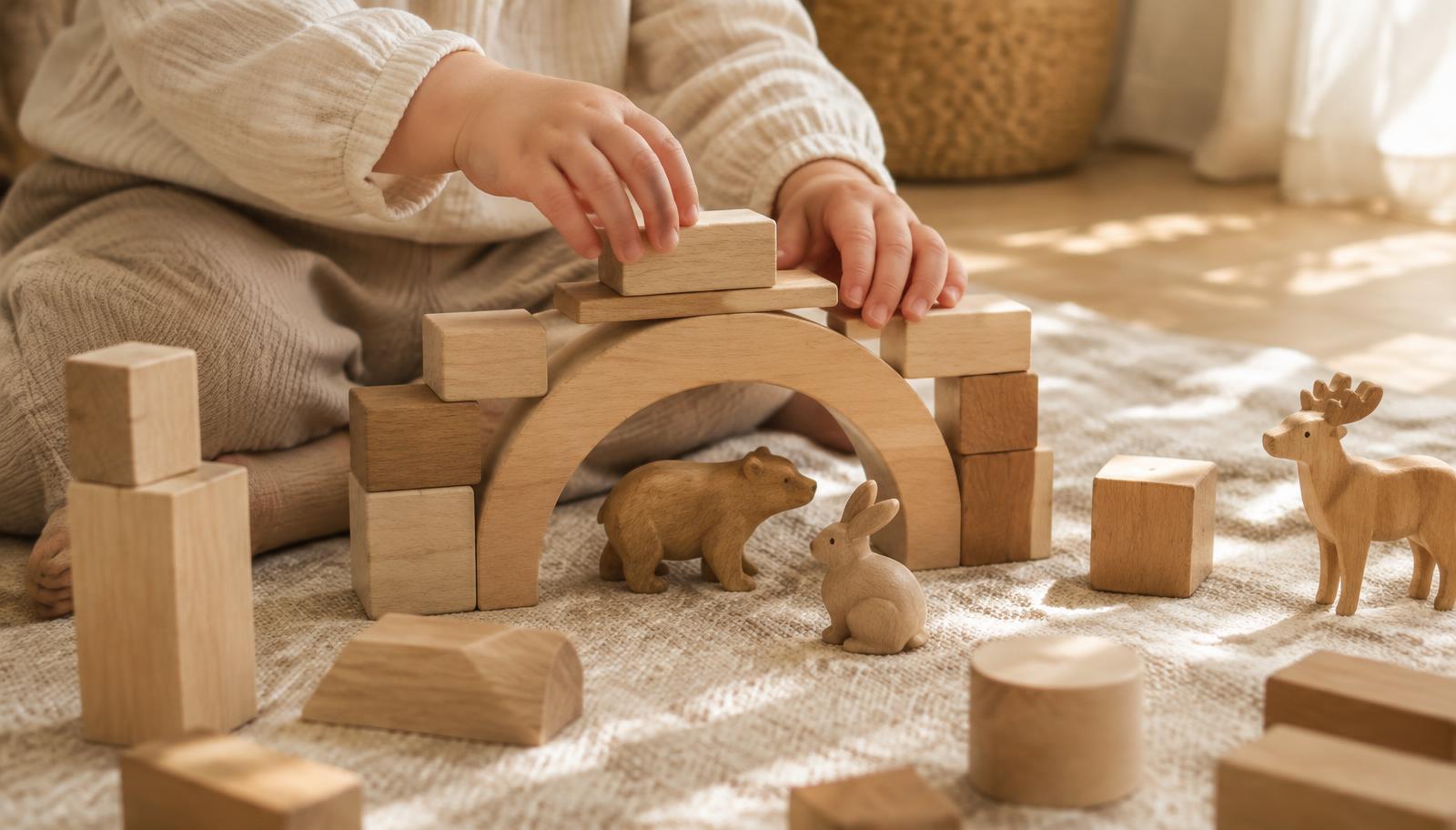
The wooden toys that last in a home are usually the simplest. A stacking rainbow like our Little Landscape Rainbow can be a tunnel, a bridge, a cradle or a set of hills for small animals, and it grows with your child from about one year to five or six. A set of carved animals such as the Forest Friends Set invites storytelling that becomes richer every year. A good basket of natural objects, like the Gathering Basket, works beautifully for babies and later becomes a collecting basket for walks.
These are what I call open-ended toys: they do not tell your child what to do. We explore this idea in the quiet power of open-ended play and in our guide to open-ended toys for busy toddlers.
Buying by age, not by aisle
One of the most common questions I get from Maltese parents is simply: what should I buy for my child's age? For newborns to six months, think high-contrast pictures, a simple rattle and a natural teether. Our guide to the best toys for six month olds goes into detail. From six to twelve months, treasure baskets, stacking cups and balls to chase. Around the first birthday, push and pull toys, simple stackers and first board books, all covered in the best wooden toys for one year olds. By two and three, small-world play, art materials and imaginative sets come into their own.
Fewer toys, chosen well
If you only take one idea from this guide, let it be this: you need far fewer toys than you think. A Maltese apartment fills up quickly, and a child surrounded by forty toys often plays with none of them. Six or eight beautiful pieces, rotated every couple of weeks, will hold attention far longer. Our toy rotation guide for Maltese apartments shows exactly how to do it.
The best wooden toy is the one that is still being played with three years from now.
Buying wooden toys as a gift
Wooden toys also make some of the most memorable gifts, especially for christenings, first birthdays and Christmas. They look beautiful unwrapped, they photograph well, and they are often kept long after childhood. If you are buying for someone else's little one, have a look at our Maltese godparent gift guide, our baby shower gift ideas or browse the ready-made edits on our gifts page.
Caring for wooden toys in our climate
Wood is wonderfully forgiving, but it does appreciate a little care. Wipe toys with a damp cloth and mild soap rather than soaking them, and let them dry naturally away from direct sun. In humid months, store them somewhere airy rather than in sealed plastic tubs. Once or twice a year, an unpainted toy can be refreshed with a little food-safe oil or beeswax balm. Looked after like this, a good wooden toy can easily pass to a younger sibling or cousin.
Shopping locally, thoughtfully
Choosing a smaller, curated shop means someone has already done the sifting for you. Every piece at Little Curio is chosen by me, a mum in Malta, because I would happily give it to my own child. You can start with the full collection, or read more about who we are. And if you are slowly turning a room at home into a calmer play space, our guide to raising a Montessori baby in a modern Maltese flat is a lovely next step.
Wooden toys will not transform family life overnight. But a few well-made, beautiful things, chosen slowly, can make the everyday feel a little calmer, a little more curious and a little less cluttered. That, for us, is the whole point.